About us

Campus Crops is a student run urban gardening initiative at McGill University's downtown campus. We want to grow food on campus, by students, for students. We have been running garden behind the School of Environment building at 3534 University since 2007. In 2009 we started a terrace garden behind the James Administration building. We're really excited to keep improving these two spaces, and need lots of helping hands for the summer ahead! Get in touch and get gardening!

Wednesday, July 24, 2013

The Midnight Kitchen is hiring!

***MK is hiring for 5 positions! ***

Deadline is August 9th at Midnight.


Please provide a cover letter and list 3 references. A maximum 1 page cover letter will be accepted through email at mkhiring2013@gmail.com or mail courrier at: Midnight Kitchen 3480 Mctavish street room 414 Montreal, QC H3A 0E7

You can apply for multiple positions but please submit a different cv for each position applied for. 

The Midnight Kitchen is a non-profit, volunteer run collective dedicated to serving healthy food to as many people as possible. We aim to empower individuals and communities by providing a working alternative to current market based systems for food collection and distribution. We provide education on food issues, and a space for an exchange of ideas within the community. We recognize that much of the politics surrounding food production and distribution are part of a larger system of oppression. By reclaiming control over the distribution of food in our community we are acting in the pursuit of social and environmental justice and we will support others who share these goals. We organize and act according to principles of anti-oppression.

We are hiring for the following positions:

Driver/Pick-up Coordinator (6-8 hrs per week/8 months, pay scale $11.96, start date: August 26th)

Volunteer Coordinator (8-10 hrs per week/ 8 months, pay scale $14.30, start date: August 26th)

Kitchen Coordinator (12-14 hrs per week/ 8 months, pay scale: $14.56, start date: September 2nd)

Outreach Coordinator (16-18 hrs per week/ 12 months, pay scale: $15.08, start date: August 26th)

Finance Coordinator (16-18 hrs per week/ 12 months, pay scale: $15.08, start date: August 26th)

*The Midnight Kitchen is a collective that uses consensus decision making and is non-hierarchical, all applicants should be prepared to work collaboratively and make decisions in a group*

We conduct hiring on the basis of employment equity. Employment equity is designed to compensate for the nonexistence of a level playing field with regards to people's experiences and job qualifications, given the structural injustice that affects marginalized groups within capitalism. These groups include but are not limited to: indigenous people, people of color, women, queer people, trans* people, people with disabilities, and working class people.

if you wish to be considered for employment equity, include the following sentence in your cover letter ‘I would like to be included for employment equity.’ Please note that we do not require applicants to specify the basis on which they are applying for employment equity.

------ Descriptions Below -------


1. Outreach  Coordinator
  •     Networking with other organizations both on and off campus.
  •     Work a minimum of 3h/week in the kitchen (i.e. at least one coordinating shift)
  •     Organizing a minimum of 2 workshops on social justice topics and other events per semester including the summer, this includes coordinating the annual ‘Put Your Politics where Your Mouth Is’ series, as directed by the Midnight Kitchen collective
  •     Working to update the MK library and purchase new books
  •     Communicating with Alternative Libraries database and attempting to incorporate the Midnight Kitchen Library
  •     Attending Midnight Kitchen collective meetings and updating the collective on political programming, networking, and outreach projects.
  •     Designing workshops that Midnight Kitchen can present
  •     Coordinating making and serving food at the Annual Anarchist Bookfair (summer)
  •     Writing a detailed exit report
  •     Maintaining a log of hours worked
  •     Working with the collective to brainstorm and generate ways that Midnight Kitchen can take political action outside of daily servings and solidarity servings
  •     Coordinating two issues of the Midnight Kitchen newsletter a year (in collaboration with volunteers and the collective)


Desired skillset:

* Knowledge of social justice and anti-oppression

* Organized and able to work autonomously

* Creative and flexible

-* Outgoing

*Experience with consensus decision-making

* Good communication skills

* Experience collaborating on special projects

* Experience with event or workshop planning

* Experience working with other Montreal community based organizations and knowledge of them

* Bilingual (asset)

* Cooking skills (asset)

* Knowledge of radical student organising at McGill (asset)
 

2. Volunteer Coordinator

Individual responsibilities include:

  •     Creating and updating volunteer schedules
  •     Work at least 3h a week in the kitchen (coordinate 1 shift)
  •     Responding to requests from individuals wishing to become involved with Midnight Kitchen
  •     Working with outreach coordinators on outreach and political materials
  •     Reporting to the collective at meetings regarding volunteer management and recruitment
  •     Bottom-lining strategizing and generating mechanisms for recruitment and retention of new collective members
  •     Acting as a liaison for incoming volunteers
  •     Working with kitchen coordinator to coordinate volunteer and kitchen orientations
  •     Coordinating at least 1 politically oriented volunteer event per semester
  •     Ensure cooking coordinating shifts are covered
  •     Enabling communication between cooking coordinators
  •     Coordinating Midnight Kitchen presence and volunteers at McGill Activities Night volunteer fairs
  •     Writing a detailed exit report

Desired Skillset:

*Approachable and friendly

*Knowledge of social justice and anti-oppression

* Organized and able to work autonomously

* Creative and flexible

* Experience with consensus decision-making

* Good communication skills

* Experience coordinating volunteers

* Experience working with students or youth

* Experience facilitating workshops or orientations

* Bilingual (asset)

* Cooking skills (asset)


3.     Administrative Coordinator

Individual Responsibilities Include:

  •     Managing MK finances in an organized and transparent fashion
  •     Managing daily operations (handling petty cash and reimbursements)
  •     Working with Kitchen Coordinator to ensure replacement and repairs of broken equipment
  •     Prepare a finance update for every collective meeting
  •     Working with the Kitchen Coordinator to coordinate bulk food orders
  •     Working with Kitchen Coordinator and Midnight Kitchen collective to research the potential for large equipment purchases, as needed, and research and apply for grants as needed.
  •     Working with the SSMU (Students’ Society of McGill University) VP of finances and Operations to draft budget for next financial year
  •     Managing the Midnight Kitchen discretionary fund [if palpable]
  •     Working a minimum of 3h/week in the kitchen (i.e. at least one coordinating shift)
  •     Writing contracts for next paid positions
  •     Writing detailed exit report
  •     Develop policy binder for reference to every Midnight Kitchen collective meeting
  •     Looking into health insurance for staff
  •     Maintaining a log of hours worked
  •     Work with other students services with paid positions to figure out possibilities of a union, for people who work under SSMU.

Desired Skillset:

*Experience with accounting and Spred sheets (necessary)

*knowledgeable of Students’ Society of McGill University (SSMU) finances, administration and policy (asset)

* General knowledge of social justice and anti-oppression

* Organizational skills

* Ability to work autonomously

* Strong communication skills

* Experience in applying for grants (asset)

* Bilingual (asset)

*Experience navigating bureaucracy


4. Kitchen Coordinator

Individual responsibilities include:
  • Working with Administrative/Finance Coordinator to ensure replacement and repairs of broken equipment
  • Working with Administrative/Finance Coordinator to coordinate bulk food order
  • Attending collective meetings and reporting back on kitchen operations and logistics
  • Working with Administrative/Finance Coordinator and Midnight Kitchen collective to research the potential for large equipment purchases, as needed.
  • Increasing the physical accessibility of space and safety
  • Working a minimum of 3h/week in the kitchen (i.e. at least one coordinating shift)
  •  Coordinating food safety trainings as necessary
  • Working with the Administrative/Finance Coordinator on making small purchases to maintain the daily functioning of the kitchen (i.e. keeping the kitchen stocked with dish rags, soap, oven mitts, etc.)
  • Writing a detailed exit report

*Working with SSMU on booking the kitchen and other policies, coordinating all kitchen bookings.


Desired Skillset:

* General knowledge of social justice and anti-oppression

* Organizational skills

* Ability to work autonomously

*Experience with grant writing (asset)

* Strong communication skills

* Bilingual (asset)

*Experience managing bureaucracy

*Experience working in a commercial kitchen, knowledge of food security measures.
 

5. Pickup Coordinator/Driver

Tasks include:

  • Driving to Midnight Kitchen food pickup locations, collecting food donations, and delivering it to the Midnight Kitchen two times per week
  • Doing other driving based on organizational needs as determined by the collective
  • Liaising with the Midnight Kitchen collective to ensure that all pickups occur as scheduled
  • Working with the Midnight Kitchen collective to communicate with food donors and maintain positive relationships
  • Writing a detailed exit report


Desired Skillset:

* General knowledge of social justice and anti-oppression
* A Valid Drivers’ license

* Access to a vehicle of sufficient size for the three weekly pickups

* Ability to lift boxes that weigh approximately 20lbs

- Bilingualism (an asset)


Tasks shared among all paid positions include (Finance, Outreach, Kitchen, and Volunteer):

  •  Working on internal relationship building and internal capacity of the collective. This includes having a minimum of one workshop on: consensus, facilitation, and anti-oppression in the fall and winters semesters (total of 3 workshops/semester). Suggestion: Coordinate a minimum of 3 collective dinners or events each semester.
  •     Keeping the office and kitchen clean and organized including keeping computer and printer functional
  •     Maintaining communication with the Students’ Society of McGill University executive
  •     Respond to emails and other Midnight Kitchen correspondence, including emails, in a timely fashion.
  •     Coordinate hiring procedures and have positions evaluated and contracts approved by the time new people are hired (including summer position)
  •     Work on documentation and maintain collective memory (including keeping records of your work, and compiling and organizing collective and committee meeting minutes)
  •     Being aware of and up-to-date on all policy
  •     Generating strategy/mechanisms for actively recruitment of new collective members throughout the year
  •     Updating outreach media, promo materials, website, facebook, consider twitter.
  •     Working on making the kitchen a more physically accessible space (have an accessibility audit)
  •     Working on maintaining MK internal network. Try to generate mechanisms to stay in touch with past volunteers/collective members.
  •     Keeping track of events and meetings in order to respond to general inquiries
  •     Assisting with the annual ‘Put Your Politics where Your Mouth Is’ workshop series, as directed by the Midnight Kitchen collective
  •     Ensuring that the task of facilitating collective meeting is rotated
  •     Coordinating a collective “Visioning” meeting once a semester
  •     Shared tasks with volunteer collective members whenever possible.

Thursday, June 13, 2013

Gardening hours Summer 2013

Our gardening hours for this summer will be:

Mondays: 4-6pm (followed by a meeting at 6pm)
Wednesdays: 11am-1pm
Saturdays: 2-4pm

No need to commit to a particular gardening time. Join us regularly (or not) in the garden!

For any questions, email us at campuscrops@gmail.com

Saturday, June 8, 2013

For the love of potatoes

You've built your potato box (properly). Your potato seedlings are ready. Then what?

The best time to plant potatoes is from mid-March to mid-May, when the soil has reached a temperature of 16°C. Plant the each potato seedling about 12-14 inches (30-45 cm) apart. If you're working with a potato box, add enough soil to completely bury the potatoes. In a garden, you can dig a trench (or individual holes) about 30 cm deep and put just enough soil to completely bury the potatoes (don't fill the trench or holes to the top yet). In both cases and if working with potato seedlings, make sure the shoots are facing upward, and make sure not to break them while burying the seedings.

Make sure that the potatoes are planted in a full sun area (at least 6 hours of sun a day), and keep the soil moist but not waterlogged. If the soil gets too dry, there will be hollow areas inside the potatoes, but if it's too wet, the potatoes will rot. Potatoes should be planted in a soil with good drainage (sandy to loam, clearly not clay), otherwise they will most certainly rot.

Once the plants have reached about 30 cm in height, add 20-25 cm of soil around the plants, either from between the rows in a garden, or from elsewhere if using a potato box. If in a garden, the initial "hilling" will most likely consist of completely filling back the trench or holes to ground level. Hill again once the plants reach another 20-30 cm in height. Repeat until plants are dead, in September or October when it gets colder (if they die earlier, it may be because the potatoes are rotting).

Potatoes do not compete well with weeds, so keep their environment weed free throughout the season. You may also want to remove any flowers if the plant blossoms.

Here's how our planting went:

Since our potato box will be sitting on concrete all summer, we added some left-over rocks we were using for our containers at the bottom of the potato box. We added about 10 cm. That should not be necessary if the potato box is a few centimeters above the ground, or if it's placed in the garden. In fact, we're not even sure if it was necessary in our case, since our soil is of good quality and should drain easily, but we did it anyway.


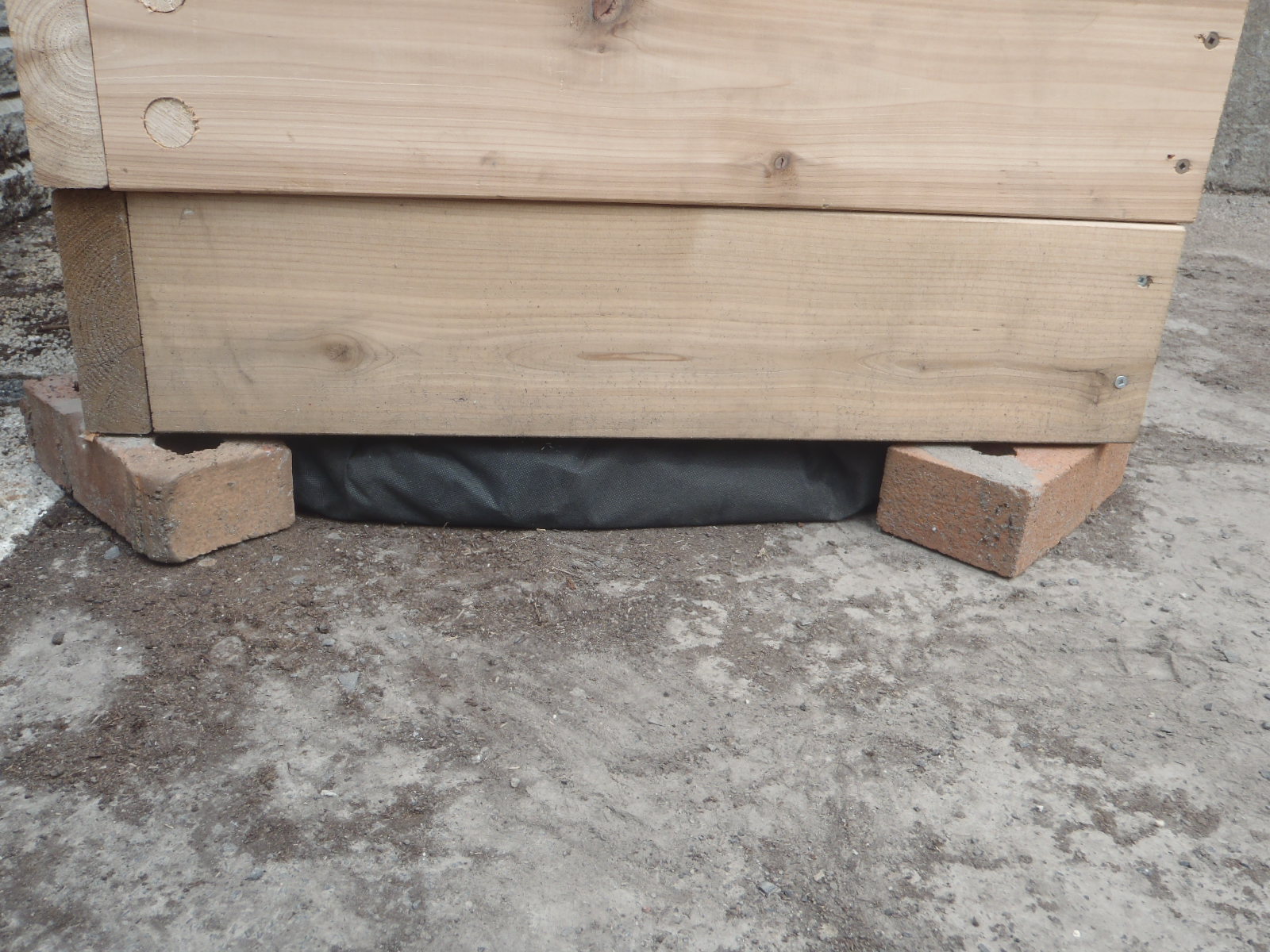
Our potato box has been lifted from the ground with bricks in order to keep the wood well aerated and prevent rot. We didn't have anything to keep the soil from touching the ground, though, so that's why we added rocks.

We then added another piece of geotextile over the rock layer and filled the potato box with about 15-20 cm of soil. We'll probably keep on putting geotextile to prevent the soil from touching the wood, as wood-soil contact may accelerate wood decomposition.


Then we dug the holes and placed the seedlings.


And finally filled the holes.


Some of our seedlings seemed to have started developing leaves at the end of some shoots, so we left those sticking out of the ground. It might not have been a good idea, as three days later the leaves seem to be dying. We're not sure if that's because it's been rainy and the soil is too wet, if the quite cold temperature shocked the seedlings and/or the leaves during transplantation, if we should have buried the whole seedlings, or if it doesn't matter. Time will tell.


Thursday, June 6, 2013

Step by step how to make your own self-watering container (plastic reservoir method) with pictures!

Because it's good to know, here's one of the multiple ways you can make your own self-watering container. This method has the advantage of being both cheap and homemade, yet doesn't make the container as heavy as with the rock reservoir method.

What's a self-watering container, you ask? Well, self-watering containers do not literally water themselves, but they do help water plants less often.
The principle is quite simple: water is poured down a pipe directly in a water reservoir, sitting under the soil. There, a wick takes the water from the reservoir to the soil. As the plant(s) use the water made available to them in the soil, the wick takes more water from the reservoir to the root zone of the plant(s). In some way, the plants water themselves (but they don't, also, you know).
Source: http://cache.gawkerassets.com/assets/images/lifehacker/2009/03/2009-03-30_113406.png

You'll need:

- a plastic container that will offer enough space for a decent-sized water reservoir and the roots of your plant, often at least 30 cm in width, length and depth for vegetable crops; check up the spacing requirement and soil depth needed for the plant(s) you want to grow in your container if you're not sure what size you need
- a sealant (maybe)
- plastic boards
- PVC pipe, about 1 inch diameter
- geotextile, as cheap as you can get
- perlite
- good soil
- compost (maybe)
- something that cuts
- a saw
- a drill or something to pierce a hole through hard plastic


The plastic we use for this model is Coroplast, which you can probably find at your local hardware store, or at your local deputy/MP/whatever office not long after an election period (or in the streets during the election period, but this is not usually recommended and Campus Crops doesn't suggest you do it either oh heeeellll noo!). Other types of plastic can work too, but they need to be both quite rigid, while being soft enough so you can cut them quite easily. 

PVC pipes, geotextile, perlite and soil can all be bought at a hardware store too (don't ask your MP for those, though).

Anywho, let's unleash them pictures.

THIS IS IT


1) No matter what type of container you use, make sure it's watertight near the bottom, and drill an overflow hole anywhere between 7-15 cm from the bottom of the container, depending on the size of said container (you want as much soil as possible in there, but too much soil for too little water won't help either). If your container is not already watertight, we suggest using this sealant, or any other sealant that works in water, works with plastic, and is not toxic. Extra points if the product description mentions that it's safe for sealing aquariums (aquaria? whatever, if it's good for the fish, it won't poison your vegetables).

2) Cut your plastic into strips that will fit lengthwise and widthwise. For the width of the strips, see step 3. Calculate you'll need a strip every 20-25 cm in both directions (lengthwise and widthwise) at the bottom of your container. Cut slits into the strips where they will intersect with other strips.


3) Arrange the strips into a grid pattern at the bottom of your container. An important thing about the width of the strips is that the grid must be about 1 inch (2.5 cm) above the overflow hole you pierced in your container. This is to ensure a good airflow in the soil and the reservoir even when the latter is full of water. Otherwise, expect anaerobic conditions, pathogens, diseases, death, and the four horsemen of the apocalypse.

Fits perfectly!


4) Cut another piece of plastic to cover the bottom of your container. Put it over the grid. Voilà! That's your reservoir! 

Some people like to leave the corners uncovered, either to use them at wick (more about this later), or to put the PVC pipe. If you don't want to do that, make sure you cut out a hole somewhere to insert your pipe.

Fits perfectly!
5) Saw your PVC pipe. Make it long enough to stick out of the container by a few inches. Saw an end at an angle, otherwise it may lay flat on the bottom of the container and water will stay stuck in the pipe instead of going into the reservoir. Insert the pipe in a corner or along one side of your container.


6) Make a wick. A wick is something that will get the water from the reservoir to the soil (by capillary action), to make it accessible to the plant. Without a wick, the water would just sit at the bottom of the container and your tomatoes would be like "Meh."

A wick must be 1) about as high as your reservoir, 2) durable, and 3) full of small holes (so the water can get in easily but the wicking material doesn't get out).


7) Cut out a hole for your wick.


8) Cut a geotextile piece that is about 5-10 cm wider and longer than your container. Cut a slit in it and insert your wick. Make sure you cut the slit vis-à-vis the hole for the wick in the container. Put the wick in the hole in the container and lay the geotextile so it extends a bit on each side.


9) Put enough soil in your container to fill your wick. Mix in some perlite (about a fifth of the soil you added).  Dump the mix into the wick. Perlite helps keep the soil light and well aerated, which various macro-organisms normally do in the ground. If perlite and soil are not mixed together before being added to the wick, it can be quite hard to make sure the wick contains a good mixture of both when the container is full. 

If you prefer to mix your soil and perlite before adding them to the container, skip this step.


10) Fill the container with soil and top with perlite. Make sure to keep the geotextile on the sides as you fill the container with soil. Mix thoroughly the soil and perlite. What we're looking for here is the unfamous reversed-color chocolate chip cookie dough mix, where the perlite would be the white chocolate chip and the soil would be the chocolate cookie dough.

If you have "weird" chocolate chip cookie tastes (not sure there's a standard or anything about what is a correct cookie dough-to-chocolate chip ratio), go for 4 parts of soil per part of perlite, or 20% perlite.


Put in the oven at 350F for 20 minutes and enjoy!


Radical Montreal - Urban Farming in Montréal

Here's an awesome list of pretty much all the urban agriculture initiatives in Montréal, made by Sheena from the Radical Montreal blog. The blog is a great resource to stay abreast of all workshops and events of all kinds happening in the city.


Montreal Urban Agriculture Projects

ROOFTOP GARDENS

Concordia Greenhouse
-Vermicomposting
-Greens, microgreens production
-Greenhouse plant propogation
-Workshops
www.concordiagreenhouseproject.wordpress.com

Lufa Farms
-Hydroponics/Window Farming/ Weekly CSA program
http://lufa.com/en

Santropol Roulant
-Vermicomposting, urban gardens, workshops
-Urban Beekeping
-Rooftop garden 
http://santropolroulant.org

Alternatives Rooftop Garden Project
-Four active garden projects
http://www.alternatives.ca/en/project-campaign/montreal-rooftop-gardens-project

SCHOOLYARD GARDENS

City Farm School
-Urban gardening/farming internships
http://concordialoyolacityfarm.wordpress.com/

Mackay Gardens
-Downtown raised bed planters
http://sustainable.concordia.ca/working-groups/concordia-greenhouse/projects/mackay-garden/

Loyola Campus
-Gardens
-Workshops
http://concordialoyolacityfarm.wordpress.com/loyola-farm/

Campus Crops
-McGill University campus garden, workshops
 http://campuscropsmcgill.blogspot.ca/

UQAM - Crapaud
 Garden
-Campus community garden, workshops
http://www.crapaud.uqam.ca/?page_id=6

Edible Campus
 -Campus based gardens
-Urban Beekeeping 
http://www.mcgill.ca/mchg/projects/ediblecampus/ 

COMMUNITY GARDENS

Action Communauterre 
-Community Gardens
-Workshops
-Hosts Seedy Saturdays annually
http://www.actioncommuniterre.qc.ca/

La Ruche D'art Garden
-worskhops
-demonstration garden
 https://www.facebook.com/pages/La-Ruche-dArt-St-Henri/174341355959676

City of Montreal Community Gardens
-Gardens in 18 boroughs for community use
-In some boroughs, a gardening instructor visits the garden regularly to give advice to gardeners. Some boroughs offer adapted gardens for persons with reduced mobility. 
-Materials provided include soil, a water source, tool shed or toolbox, tables, fences, sand, paint and flowers.
 http://ville.montreal.qc.ca/portal/page?_pageid=5977,68887600&_dad=portal&_schema=PORTAL

COMMUNITY RESOURCES

Éco-quartier
-With locations situated throughout Montreal, these local centres offer:
-Annual neighbourhood clean-up
-Distribution of recycling bins, composters, rain-barrel collectors and often plants.
- Education, such as natural pesticides, and environmental sustainability
http://www.ecoquartier.ca/index.php?option=com_content&view=article&id=37&Itemid=42

Montreal Permaculture Guild
-Community group, discussions, fb board
http://permaculturemontreal.org/
http://www.facebook.com/groups/66201097563/?bookmark_t=group

Agriculture Urbaine
-Group hosting events, seminar, discussions 
http://www.ecoleagricultureurbaine.org/index.html

Le Groupe de travail en agriculture urbaine (GTAU) 
-Official group who hosts events, seminars 
http://www.agriculturemontreal.info/

Radical Montreal Urban Homestead Exchange
-Live-in volunteer exchange, garden, workshops
http://www.radicalmontreal.com/p/urban-homestead-exchange.html

Gardening Network of the Southwest and Verdun
-Community resources, workshops
http://reseaujardin.org/en 

Agriculture Montreal 
-Events
-Information 
http://agriculturemontreal.com/

L’arrondissement d’Ahuntsic-Cartierville :

- un jardin collectif en bacs pour les personnes retraitées de la Porte d’Or des Iles PODI,
- incredible edible
-French only

Sustainable Montreal
-Local news in urban agriculture
http://www.sustainablemontreal.ca/tag/urban-agriculture/ 

Montreal Urban Ecology Centre
 -La Ville en vert
-Green roofs
-Imagine Milton-Parc
-School for Urban Citizenship
http://www.urbanecology.net/article/we-sign-urban-agriculture

PAUSE: Production Agricole Urbaine Soutenable
-Projects with container planting, mushroom growing, and bee-keeping. French only. 
https://www.facebook.com/pages/PAUSE-Production-Agricole-Urbaine-Soutenable-et-%C3%89cologique-/137583529654966 

OTHER RESOURCES

The Urban Farmer 
http://theurbanfarmer.ca/resources/urban-agriculture/

Guide to Soil Contamination in the city
http://mse-research.mcgill.ca/envr401_2002/brownfields/guide.pdf

If I have missed any URBAN FARMING resources for Montreal, please let me know!
Sheena.Swirlz@gmail.com


-------------------------
We might add that there is P.A.U.S.E. at the Université de Montréal

Wednesday, June 5, 2013

The beds are ready!

Last Saturday was our (last) garden opening day. After working on some containers, we were also able to make all the beds in our soil garden. Here's the result from many angles. Gardening hours to be announced soon!

All the paths are 45 cm wide (18 in.), and most of the beds are 75 cm wide (32 in.). The oval near the middle is 1m by 1.5m and will host our spiral garden. 


From the South. The central path going from the upper center-right to the oval in the middle was designed to facilitate movement with the water hose, which is plugged into the faucet under the stairs, at the upper extreme-right of the picture.


Tuesday, May 28, 2013

Better late than never!


At last! Finally! Was about time!

We know, we're quite late at the party, but a few things delayed our garden opening this year. We've decided to get things done once and for all this Saturday June 1 at 1pm, rain or shine! The weather will most likely not be perfect, so dress accordingly (at least it's not going to be 7 effing Celsius degrees like last weekend).

During the afternoon, we will assemble the self-watering containers that are not done yet (about a dozen), prepare the beds in the soil garden and, if all goes well, plant. Everyone is invited, especially people who want to be involved in the collective!

For Facebook users, there is a Facebook event.

As an hors-d'oeuvre, a few pictures:

Our new garden, finalized, although there's still a bit of work to do
 around it (none of our concerns, now that we can plant!).

Our dearest japanese knotweed has awoken from its slumber.
It is, unfortunately, quite vigorous.

A nice specimen, about 12 inches high. The little things are taking advantage
of the fact that the area is in renovation and almost impossible to mow.

Our hoop house, doing its thing behind the James Administration building.

The seedlings we got last week from the Vert-ta-ville seedling sale
at the Concordia greenhouse. Doing well despite the less-than-ideal weather!


From left to right, we got cherry tomatoes, tomatillos, parsley, peppers, ground cherries, eggplants, oregano, onions, leeks, and lavender.

The terrace, with the completed self-watering containers along the sides. Since there will be renovations around the drain, near the center, we were asked not to put any container there for the moment.

All of them containers, along with the hoop house, at the far end, and the potato box, right in front of the hoop house.